Sunday, June 8, 2014

Cave dwellings in the Ningxia Province, China

It's been quite a few years since my last post on this.  I've been travelling quite a bit in this time, but haven't really felt the motivation to write about it.  However, I came across a pretty unexpected discovery in my recent travel in China, so why not write it down.

I spent a couple of days last week hiking around the Ningxia Province in China.  Ningxia is an autonomous region located somewhere in the middle of China (towards the north), bordering on Inner Mongolia.  Much of the terrain feels a lot like desert.  Many of the areas I was walking around were supposed to be "protected" meaning that bushes have been planted and farming and grazing of animals is not allowed, to try and stop the landscape eroding into complete desert.  That apparently doesn't stop the local shepherds, from walking around with their flock of sheep.  I'm happy to cut the shepherds some slack though - if your job is to walk around watching a bunch of sheep all day, every day, for your entire life- in a place that's -30 in winter and +30 in summer - I say walk wherever you feel like it!

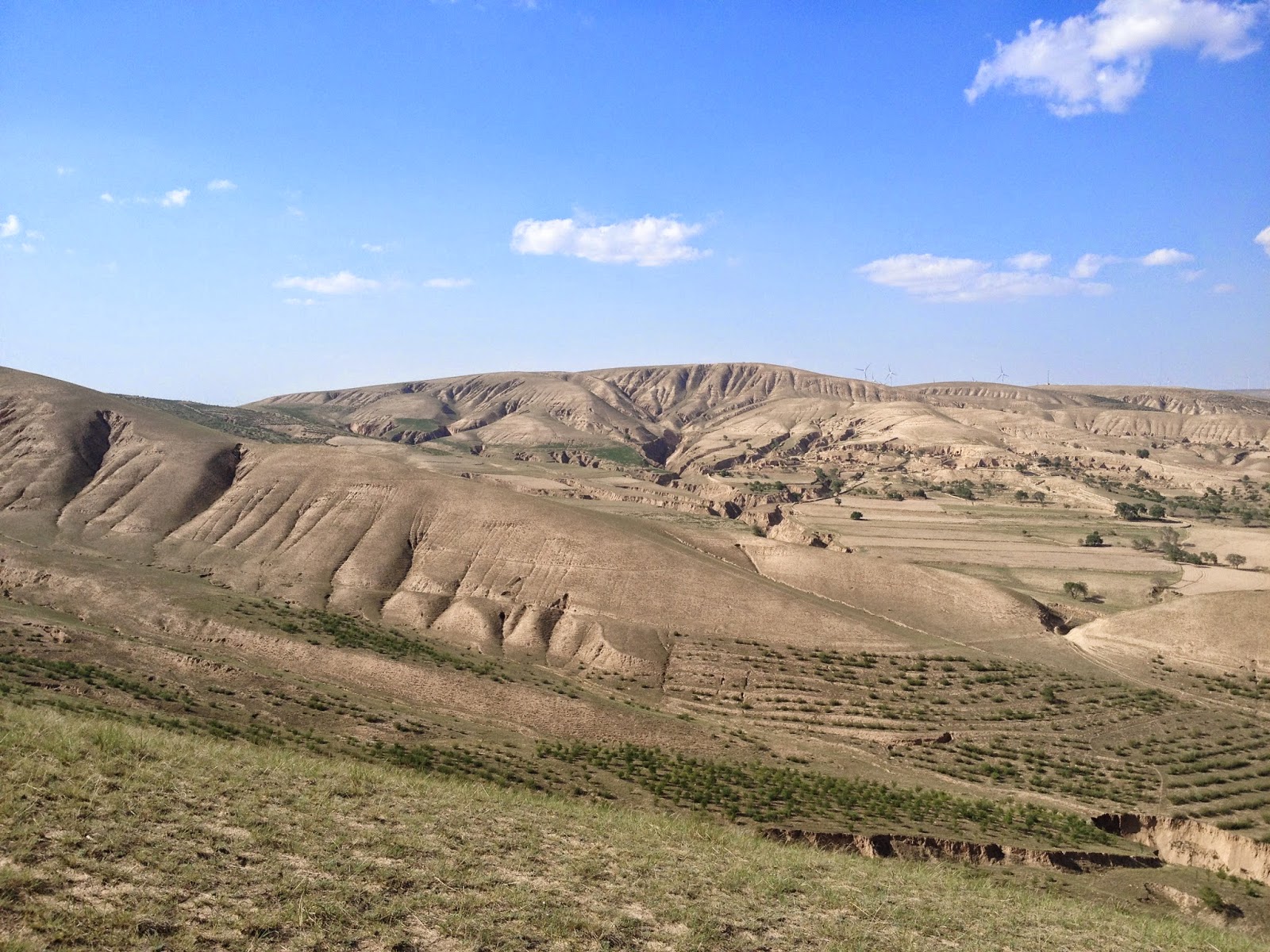
The terrain is quite amazing.  It's made up of a series of sparsely vegetated steep rolling hills.  The tops of the hills are pretty windy, so that's inspired the development of a very large wind farm in the area.  I'm no geologist, but there appears to be no rock in the area. meaning the landscape is made of soft dirt.  When it rains, you can see that this dirt just washes away, changing the landscape dramatically.  There are many trenches and valleys that you can see have been made because of the erosion of soil.  This makes for a bit of a challenge when walking around the area, trying to find the best way to avoid the steep cliffs that have formed.  I would imagine those wind turbines have some giant concrete foundations to keep them upright in the soft ground.
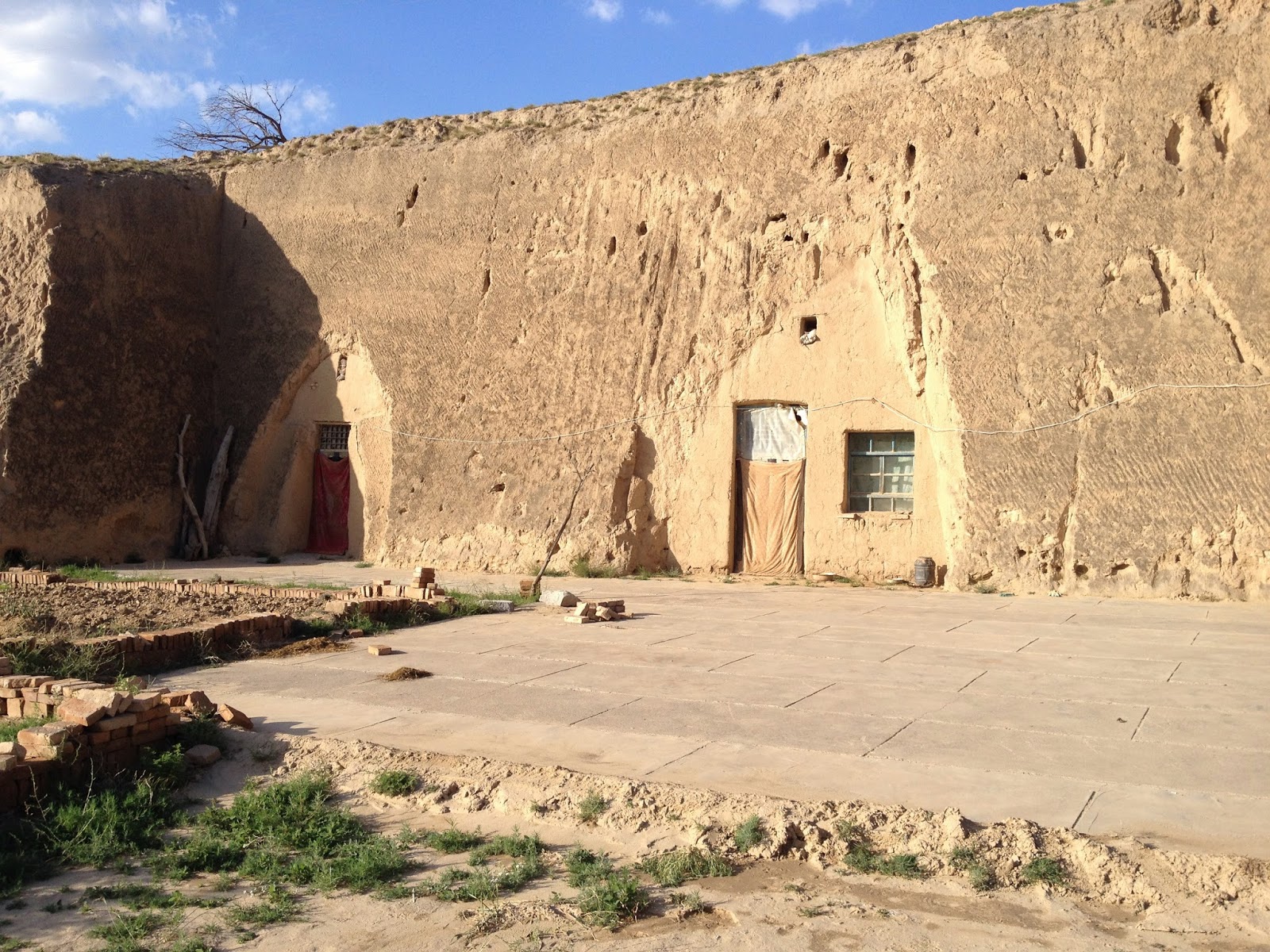
But the soft earth seems to have created a housing opportunity for people in the region.  The locals live in cave dwellings called a yaodong, dug into the side of the mountains.  This took me by complete surprise when I first saw them.  "Do people really live in those?".  Apparently, "yes" is the answer.  Some later research on Wikipedia tells me that 40 million people in China live in these style of dwellings.  Cool. I feel like quite the fool for not knowing they existed. Apparently, even Chairman Mao's revolution is famous for having started from such caves.  The caves, cool in summer, warm in winter, appear to be very practical places for people to live.
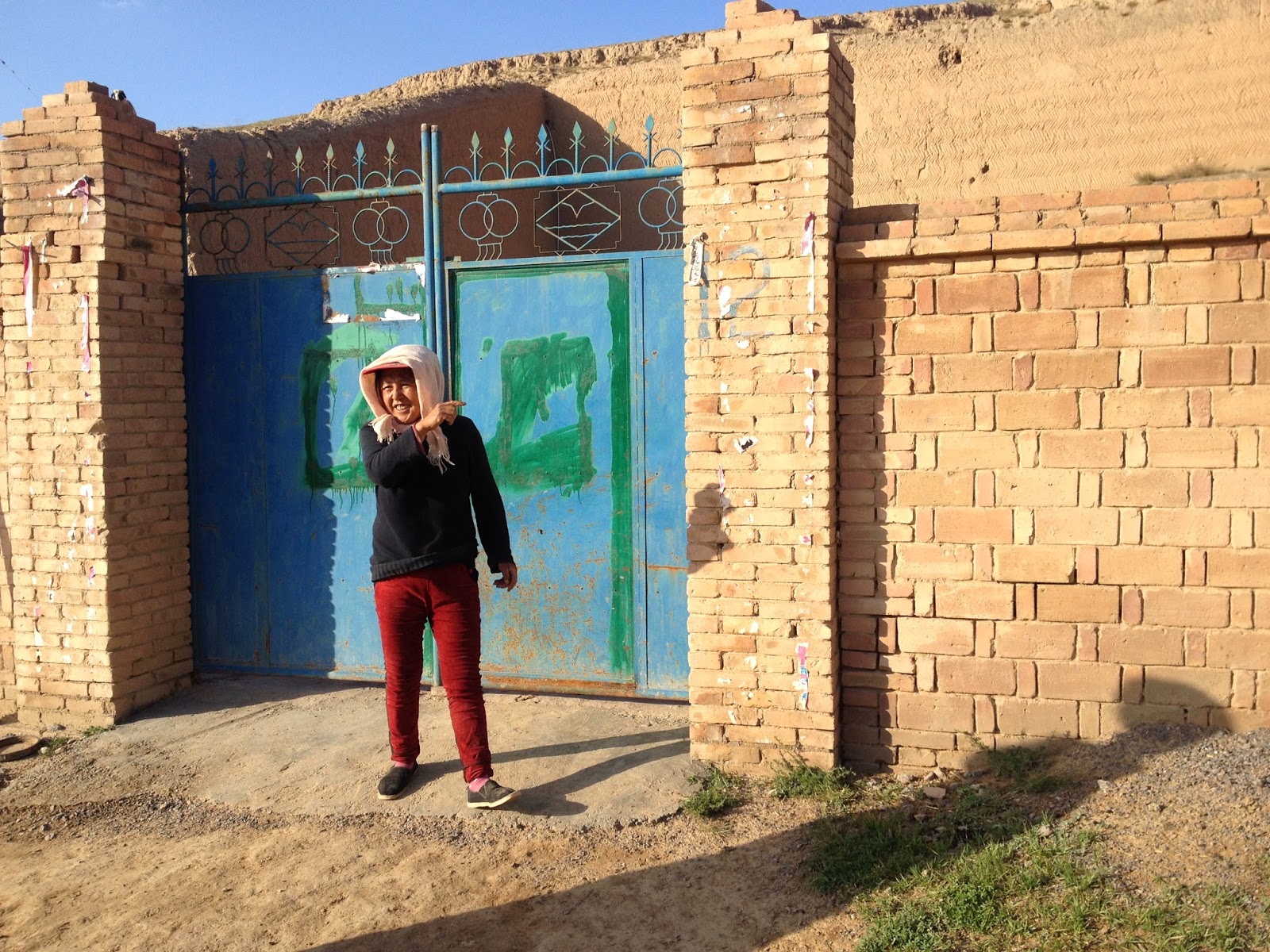
The caves vary in their size and grandeur.  Some are just holes in the side of mountains, some have decorative archways and I imagine would be quite comfortable inside.  It seems most also have electricity.  We were standing out the front of some of these caves, marveling at how people could live in one of these when a local lady approached me and my travelling group.  After a short conversation (of which I partook in only by smiling and nodding), she was very happy to show us around her caves.  She pretty much had a farm built around a few caves.  A couple of small caves used for storage of vegetables (basically fridge caves), a cave for the dog, a cave for the pig, a cave for the lambs (Ningxia is said to have the best lamb in China - can confirm lamb is tasty).  She had a vegetable patch growing out the front, and a well where she collected rainwater that washes down the side of the hill she lives under.  Her living cave was very simple - basically a single room with a bed inside...but... I did notice a massive satellite dish out the front, so all I can imagine she does is farm all day, and sit of the bed watching cable TV all night.

Words (my words at least) can't really describe this place, these people and the way they live very well.  I took some crappy photos on my phone, but hopefully they can convey one of the lesser known curiosities of China.


The dog and the pig

The lambs with dig daddy looking down from above

Lambs and their cave

Satellite TV

Inside the cave

Monday, December 14, 2009

Hong Kong


Hong Kong is probably the perfect definition of the word “city.” The place is bustling all the time with big double decker buses, double decker trams, taxis and hoarders of pedestrians always brushing past you as you walk through the streets.

In Hong Kong I stayed in Tsim Sha Tsui, which is in Kowloon. The place is full of cheap guesthouses and finding accommodation there was easy. The accommodation though was not of the greatest quality, it was quite small and not in the nicest of neighbourhoods but the location was central and suited my purposes well enough.

Watching the light show across Victoria Harbour on my first night there was incredible to see. After seeing the harbour before in movies and on TV, the scale of it was much larger in real life. Taking the tram to the peak which overlooks the city the next day gave a real indication to the sheer size of the city.

While there we visited the Big Buddha statue. To get there we had to get an overpriced cable car ride, which went for about half an hour. Unfortunately, the day was so misty that we couldn’t see anything from the cable car. I was quite disappointed in the end by the Big Buddha. Sure it was big and Buddha like, but the whole area seemed to be a tacky scam geared at taking stupid tourist’s money. For example you could not visit some areas inside the monument without purchasing an extra ticket.

The food in Hong Kong was also different… compared to the Malaysian Chinese food I’ve become used to anyway. I found Hong Kong food is less geared towards flavour, and more towards healthiness. For example, the food there was far less sweet than the food you can find in Malaysia. I also took the opportunity to try some different foods while there including a variety of odd things at dim sum, and a watery tofu dessert, which to my surprise actually tasted quite good.

Ocean Park was also a highlight of my Hong Kong trip. Being a huge fan of roller coasters I chose to visit this park over Disneyland. It’s very much like Sea World in Australia, with a few added extras. One of the best added extras would have to be the Giant Pandas. An-An the panda just sat there eating bamboo leaves the whole time, and really did look like it was a guy in a suit. The rides at Ocean Park were the standard theme park fair. I was able to confirm my love for roller coasters by sitting in the front seat of the two roller coasters they have at the park, and enjoying every second. The only problem that I found with the park was that it was too big, which made it troublesome to get around. To get from one side to the other you need to take a cable car, and then to negotiate your way around that side you need to take a series of really long, really slow escalators.

In Hong Kong I also travelled briefly into the New Territories, or the burbs of Hong Kong – where lots of the people live. About an hour out of town I was surprised with how busy the place still was. There were heaps of tall buildings everywhere which would put most city centres to shame.

See videos of places visited:
Victoria Harbour light show:


The Abyss Ocean Park - Hong Kong (take 1)


The Abyss Ocean Park - Hong Kong (take 2)


Dragon Rollercoaster Ocean Park - Hong Kong

Macau


Billed as the “Vegas of the east” and being the highest volume gambling centre in the world I was very much looking forward to my visit to Macau.

The place is very different to what I imagined. There are heaps of casinos for sure, but I found the place to lack a sense of excitement. The casinos are big, with lots of tables for most budgets. Baccarat is the game of choice, with some other Chinese games I’ve never heard of as well, but most of the games I’m familiar with were there too. Although I started off positive, in the end, craps let me down,

To me, most of the casinos looked the same. The one that really stood out was the Venetian. Apparently the 4th largest building in the world by floor space, it has to be seen to be believed. The outside is modelled to look like a series of buildings from Venice, but the inside is the most amazing. A series of indoor canals, complete with gondolas, singing gondoliers and fake sky make it quite the experience.

Aside from the casinos, Macau has a very European feel to the city with narrow cobblestone street and old churches etc. – which is a strange feeling when the city is full of Chinese people. I found that English was used a lot less than expected. Luckily I travelled with a Cantonese speaking friend, but otherwise things would have been more difficult. Most shops have signs in Chinese only.

On the plus side Macau is very easy to get around and for free too! The place is so small that you can walk to most parts yourself, but when you can’t, there is usually a free shuttle bus offered by a casino which will take you to the right general direction. As a result, paying for transport is almost unnecessary.

The airport in Macau is also quite cool and worthy of noting. The runway is quite literally a narrow strip of land in the middle of the sea, with the planes able to drive onto the runway from the airport on small causeways. The plus side to this is that take offs and landings are more exciting, the downside is that the taxying from the airport takes ages as the plane has to drive the entire length of the runway each time

Inside the Grand Canal, Venetian Casino Macau

Wednesday, November 18, 2009

Gunung Gading National Park


At Gunung Gading I was finally able to shower under a waterfall. That was one awesome feeling. In fact, at water fall number seven at the park, there’s even a rock located right under the waterfall which is in a perfect spot for you to sit on and relax for a while. When you’re sitting under a waterfall it’s a little difficult to breathe, and almost impossible to keep your eyes open, but it’s is incomparably refreshing. The river is made of really clear, really cold water which rushes over you. Unfortunately we had to leave after a while because we felt the water level was rising and thought we might get stuck.

The national park is quite a good one, not too far away from Kuching. We caught a bus with a group of students from uni to head there for a weekend barbeque. The tracks are pretty good and well marked. It was raining the day that we went so the rocks and tree roots were very slippery, but luckily, now that I’ve had a few jungle walks under my belt I was able to handle the conditions fairly well.

Unfortunately we didn’t get a sighting of a rafflesia flower (biggest flower in the world which is supposed to smell like rotting human flesh), but the day was good regardless.

Sunday, November 8, 2009

Pontianak


“Not the trip I expected it to be” is probably the best way of summing up my Pontianak experience. Pontianak is a bustling city which lies smack bang on the equator (marked by the equator monument) somewhere in West Kalimantan on the island of Borneo.

I never really intended on visiting Indonesia, but when the opportunity came up, I decided I may as well go. Not really looking forward to it, or expecting much, I was definitely impressed by the city.

I stayed at the house of a friend I was travelling with. This was an experience in itself. The householders spoke very minimal English (slightly more than my attempts at Indonesian though), so most communication was done non-verbally. The household consisted on Tante (indonesion for aunty), her two daughters and a daughter’s husband and son. The son was toddler who developed a liking for us and would always play with us, constantly talking to us in Indonesian, not seeming to mind that we didn’t understand a word he said.

In Pontianak I got my first massage. It wasn’t as good as I had thought, sometimes being quite painful, but not bad overall. I guy came to the house and it lasted about an hour in total. Once again half the fun was trying to talk to the guy who spoke very little English. Also on the beauty theme, I got my first shave from the barber using a straight razor. The best part of both was the price. The massage cost about $5AUD and the shave was about 25 cents – amazing.

Most things in Pontianak are amazingly cheap. The problem is keeping track of your money. Because the exchange rate with Indonesia is so bad I had trouble the entire time figuring out exactly how much the money I had was worth. Also, doing maths with hundreds of thousands of rupiah, while mentally trying to convert everything into Australian Dollars and Malaysian Ringitt (which I have become so used to) is confusing to say the least.

Probably the thing that I spent most money on was food. I was able to try frog for the first time. Apparently there is only one vendor in the city, and our trusty friends were able to take us there. I had deep-fried sweet and sour frogs with rice and a soup which tasted pretty good. Funnily enough, it tasted like chicken (although it was annoying to eat because the bone to meat ratio is so high). I also had a version of one of my favourite Malaysian dishes, Kolo Mee, with the pieces of pork replaced with crab meat. I have to say that the Pontianak version was better. Durian flavoured ice cream was also a winner.

It was refreshing to see the Pontianak city after spending so much time in Malaysia. It’s not really a tourist town with very few tourist attractions. There is the equator monument and a mall (which we spent a surprising large amount of time in) – but that’s about it. People in Indonesia seem active, and will do things even if there is no air-conditioning (unlike Malaysia). The driving is mad. The craziest I have ever seen. The roads are clogged with scooters, driving past in random directions at various speeds. Road rules are non-existent, as are lane markings. But somehow it all seems to work. It all adds up to make Pontianak a really interesting place.

Getting to and from Pontianak was half the fun. We caught a bus from Kuching to Pontianak. The bus ride takes ten hours in total. Crossing the border was a challenge. We were able to buy a visa for 10USD (I found it really strange we had to pay in USD) but when trying to pass through immigration it seemed that the guy had never seen a foreign passport before and didn’t know what to do with it. After much stuffing around he finally figured it out… but just as he was processing my visa the power went out. Apparently this is a usual occurrence. After waiting a total of about 45mins the power was back on and we made it through. The people on the bus didn’t look too happy that we held them up- probably not the best way to make new friends. But friends we did make somehow. The lady sitting next to us invited us to her place for “roast chicken and cheese” but unfortunately we had to decline.

The border crossing on the way back was also tough to get through. We were at the border before 5am (waiting for it to open)… but unfortunately it seems the rest of Indonesia had the same idea. So after about 2hrs of waiting in line we made it back to Malaysia.

Monday, October 26, 2009

Manchester United


I don’t know what it is about English football (soccer, for all intents and purposes), but the people in Malaysia love it. Especially Manchester United. Everyday you’ll see people walking around in Manchester merchandise (even beanies – though it’s over 30degrees everyday). Cars are decked out with Man U stickers, and the letters MUFC appear in random places (it took me a while to figure out what it was… then it clicked that it was Manchester United Football Club.

What’s more surprising is that Malaysians seem to love this sport even though they are terrible at it. There is no national team of note, and even the locals at uni can’t keep up to the pace of the international students. I think I can put it down to Manchester United’s successful marketing campaign in Asia… but the widespread interest still amazes me – it’s comparable to Melbournian’s love of AFL.

So it was no surprise that the “battle of the reds” (rivals Manchester United V Liverpool) was preceded with much hype. I heard adds about it on the radio starting from about a week in advance. The best part was when the warden of the hostel I am staying at arranged it get a temporary Astro satellite TV connection into the courtyard of the hostel, so he could broadcast the game on a projector for all to see.

There was a big turnout on the night of the game (Sunday night, 10pm), with a large percentage of the hostel residence turning out to watch the game. About 70% of the crowd was Man U supports, with the rest not really caring and supporting Liverpool for the night just to egg on the Man U fans.

The game was a good one, and it was backed up by one of the loudest crowds I’ve ever seen (almost worst than drunk guys watching the footy at the pub), with people screaming at the referee, the players, at each other, and just screaming in general. Towards the end, the crowd started getting quite rowdy and I was surprised there wasn’t a riot.

The 2-0 scoreline in Liverpool’s favour, crushed the fanatical Man U supporters, and after some angry outbursts eventually silenced them. I can’t wait to see the fireworks at the upcoming uni futsal tournament.

Friday, October 23, 2009

Bau Longhouse and Lundu Waterfall Weekend


Another weekend another trip, the homework is starting to accumulate. Nevertheless, this weekend it was our university librarian who led us on a memorable experience to stay a night in a longhouse.

A convoy of two cars set off on Saturday afternoon to a small village near Bau (southwest of Kuching). When we arrived there we were introduced to a man known only as ‘Uncle’ who treated us to some interesting snacks and drinks. These included glutinous rice cooked and served in pitcher plants – amazing – and something you could only find in Borneo.

After the daily torrential downpour (which I have come to expect in Kuching), which lasted about an hour, we commenced our hour long trek from Uncle’s house, through the jungle, to the longhouse, where we were to spend the night. The walk was tough going, mainly because we had to carry all our own supplies up, which included a large (and heavy) icebox. However, after some hard work we made it to the village at the top of a hill just as light was fading.

The small village consists of a handful of wooden houses (only one of which is occupied by locals – the rest look well maintained though). We were the only tourists there. The locals came and cooked a feast for us that night which included rice, chicken mixed with some flowers cooked in bamboo, pork in durian paste soup and small chunks of BBQ pork face (yes… nose, ears cheeks etc). We ate on the floor in candle light. It was a good meal, but I found the pig nose a little hard to digest. Uncle entertained us for the rest of the night with his sayings and sugar cane wine (which he makes himself).

One of the many highlights of the night was the random bat which flew into the house and flew around for a while scaring the daylights out of some. It must have had some made sonar.
.
The next day we headed off in search of a waterfall near the town of Lundu. I thought this would be nearby, but I was wrong. Without a bit of local knowledge from our librarian/guide, we would have never found this place. It is definitely off the map, and I doubt you could find it any guidebooks. We drove somewhere in the direction of Lundu, then went down a gravel road for about half an hour. This led us to the middle of nowhere, where there was a small Kampong with dogs and roosters running wild.

Here we met our local guide who was to take us to the waterfall. This is the first time we have actually needed a guide. The path to the waterfall is unmarked and towards the end does not exist at all. We were led into the jungle to a river (I swear at one point monkeys were throwing things at us from the trees… but I had no confirmed sighting of them). At the river the narrow path ended, and we travelled upstream, barefoot climbing rocks and jungle until we got to a huge waterfall. The entire walk took approximately an hour, but it was certainly worth it.

The water was freezing cold and the current was strong, which was perfectly refreshing after the walk. We spent a while swimming around at the base of the waterfall, with the more adventurous members of our group diving in from the rocks which surrounded. Another highlight was finding the “washing machine” – a natural spa, and the “waterslide”, slippery rocks which we were able to slide down uncontrollably.

All good fun, now back to that homework.